At Music Snippet, we love talking with our users: whether it’s with useful product feedback to simply some kind words, they keep our daily motivation levels soaring high. Recently, we spoke with Angela Reichenbach, a teacher from Canada, about how she’s been using Music Snippet to design a new gospel music curriculum.
Why Building a Music Curriculum Is So Hard
Any experienced music teacher will tell you: a well-structured curriculum makes all the difference. Research backs this up. Studies in Music Education Research and the British Journal of Music Education consistently show that thorough curriculum preparation improves both teacher confidence and student outcomes.
The problem has always been the logistics. Pulling together written notation, lesson materials, and exercises into a single, shareable document used to mean juggling three or four different applications: score editor, screenshot tool, word processor, PDF exporter. It was slow, inflexible, and broke the moment you needed to make a change.
Angela knew this firsthand. With nearly 30 years in music classrooms, she'd tried most of the solutions out there. None of them were good enough.
The Challenge: A Gospel Curriculum Built from the Ground Up
Angela's task was to develop a year-long music curriculum for adult gospel students at the Zamar Music Academy in Toronto. Gospel music is typically passed down by ear in church settings — so while students learn by listening first, the teachers still need written materials that include notation for chord progressions, scale degrees, and vocal exercises.
She was starting from a blank page, in Google Docs, and needed a way to embed real music notation directly alongside her lesson text.
Why Traditional Tools Didn't Work
Angela had explored notation software before. The problem wasn't finding tools, but it was that none of them actually integrated with her workflow:
"I didn't want to write the music somewhere else and then need to cut and paste it in. There's stuff out there for that, but it's complicated, it's not click-and-drag, it's not quick."
The core issue: every existing option treated the document and the notation as two separate things. You'd write your music in a notation app, export an image, paste it in, realise you'd made an error, go back to the app, fix it, re-export, re-paste. Repeat endlessly.
What Angela needed was a tool that lived inside Google Docs — not alongside it.
Discovering Music Snippet: "I've Learned Just by Clicking"
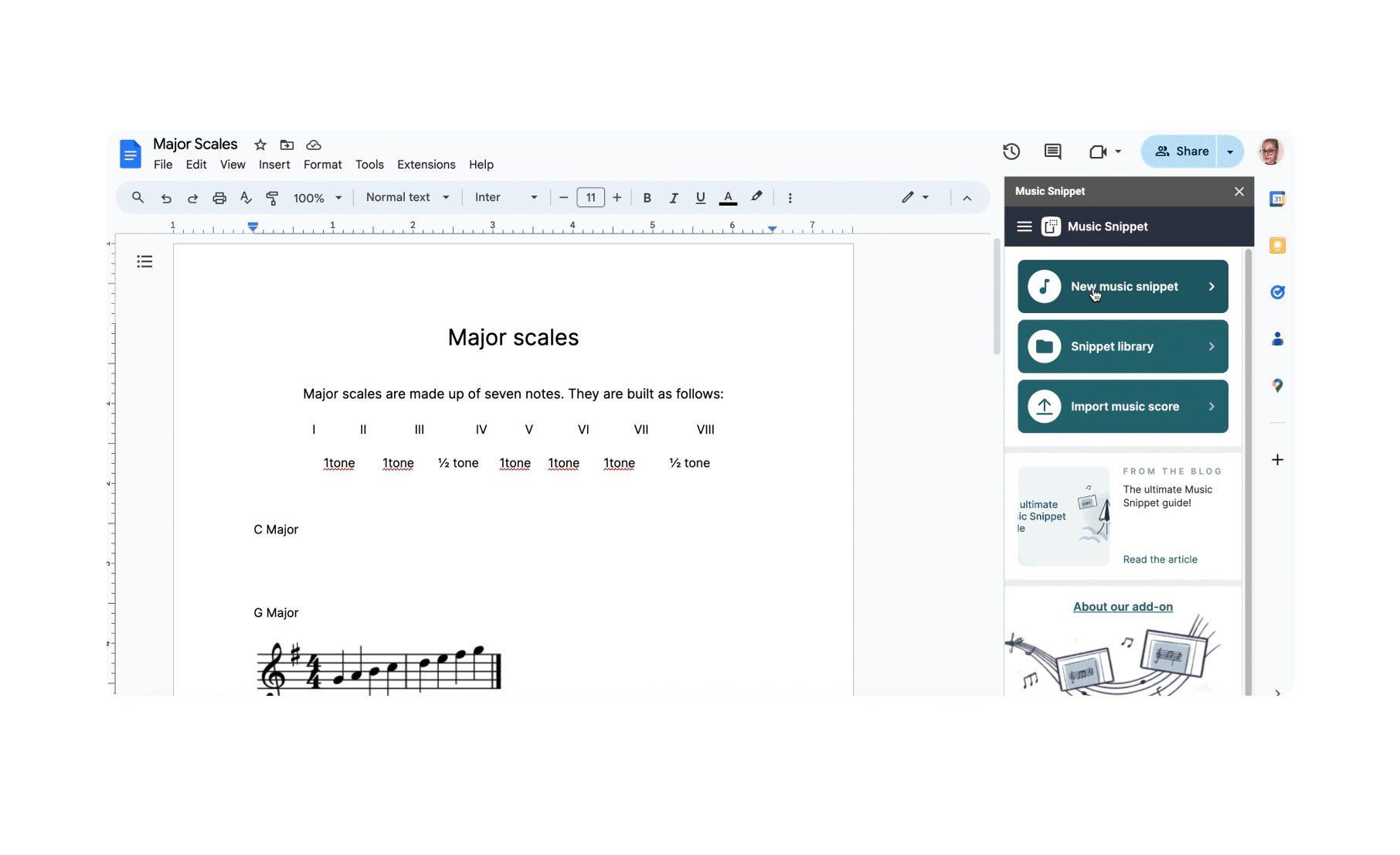
While working on her curriculum in Google Docs, Angela came across Music Snippet in the Google Workspace Marketplace. It's a free add-on that lets you create and embed music notation directly inside Google Docs and Google Slides — no switching apps, no exporting images.
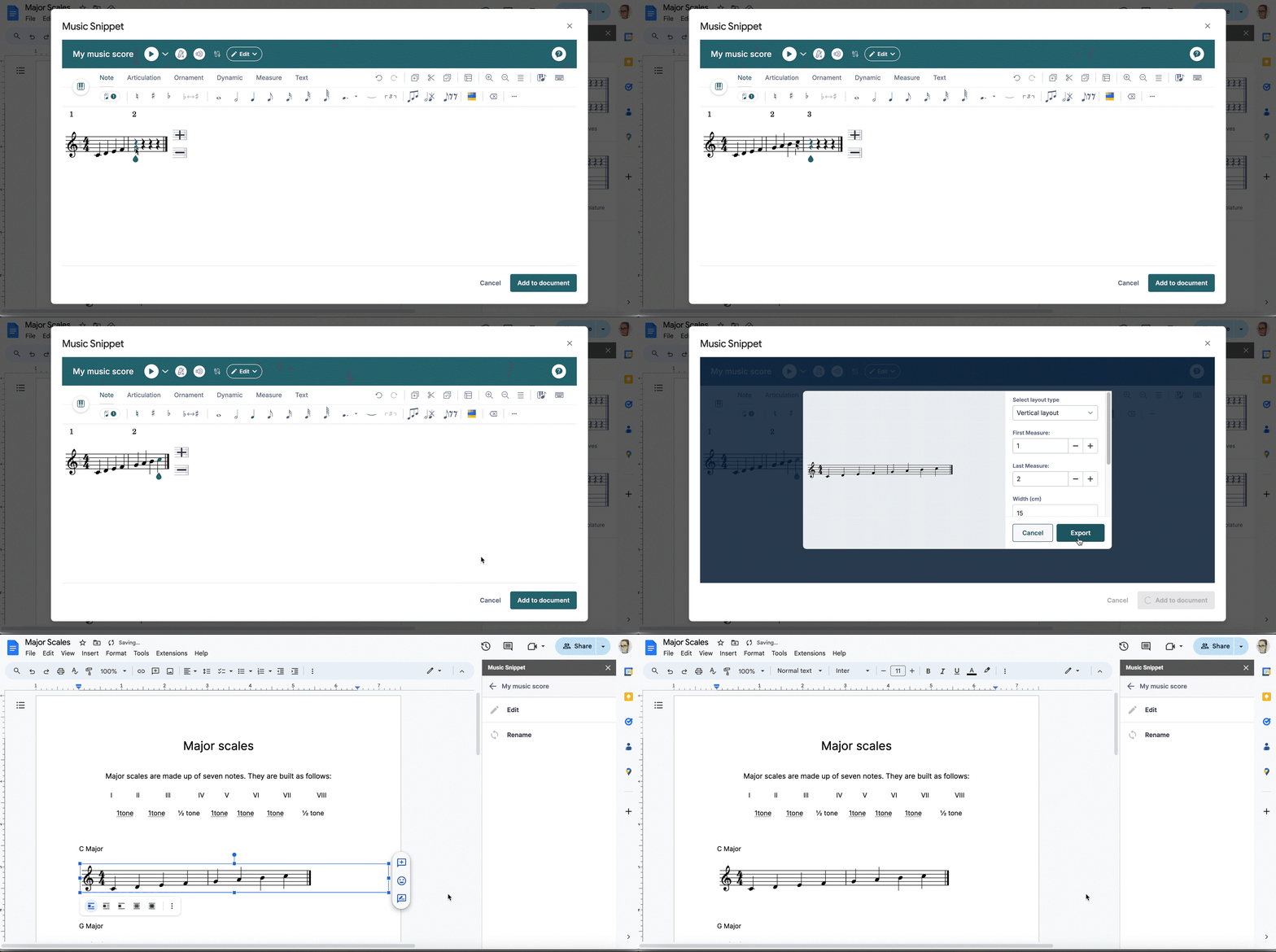
💡 New to Music Snippet? It takes about two minutes to install from the Google Workspace Marketplace.
Go to Add-ons → Get Add-ons → search "Music Snippet" → install.
That's it.
Her first impression was exactly what the name promised:
"I wanted something quick, and when I came across even just the name in Google Docs, 'Music Snippet,' it said to me it would be quick. And it is!"
The learning curve was minimal. Angela describes her onboarding process simply: clicking around and figuring it out as she went.
How Angela Built Her Curriculum Section by Section
Creating Vocal and Piano Exercises
Because gospel music isn't widely taught in formal school settings, Angela had to create most of her materials from scratch by drawing on her own expertise in vocal anatomy and the Estill Voice methodology.
"I'm a big fan of the Estill Voice methodology, and I use it with both younger and older learners. I've built tasks that help with the intervals that show a person can go from thick to thin on vocal folds. So I'm not just describing a lesson — I can create the right practice clips and have them in the curriculum, all ready to go."
With Music Snippet, she could write the notation directly into the section of the document where it belonged, no back-and-forth required.
The "Intelligence" That Saves Time
One of Angela's favourite features is what she calls the tool's built-in intelligence. When writing a sequence of exercises that all use eighth notes, for example, Music Snippet continues in eighth notes automatically rather than resetting to default settings each time. It adapts to the musical context you've established.
For a curriculum that needs to flow logically from one section to the next, this kind of continuity matters. It means less time in settings menus and more time writing music.
Sharing and Expanding the Curriculum
Once the curriculum was drafted, sharing it with colleagues was straightforward. Google Docs can be exported to Word (.docx) or PDF, so the document could be distributed in editable or read-only formats depending on the situation.
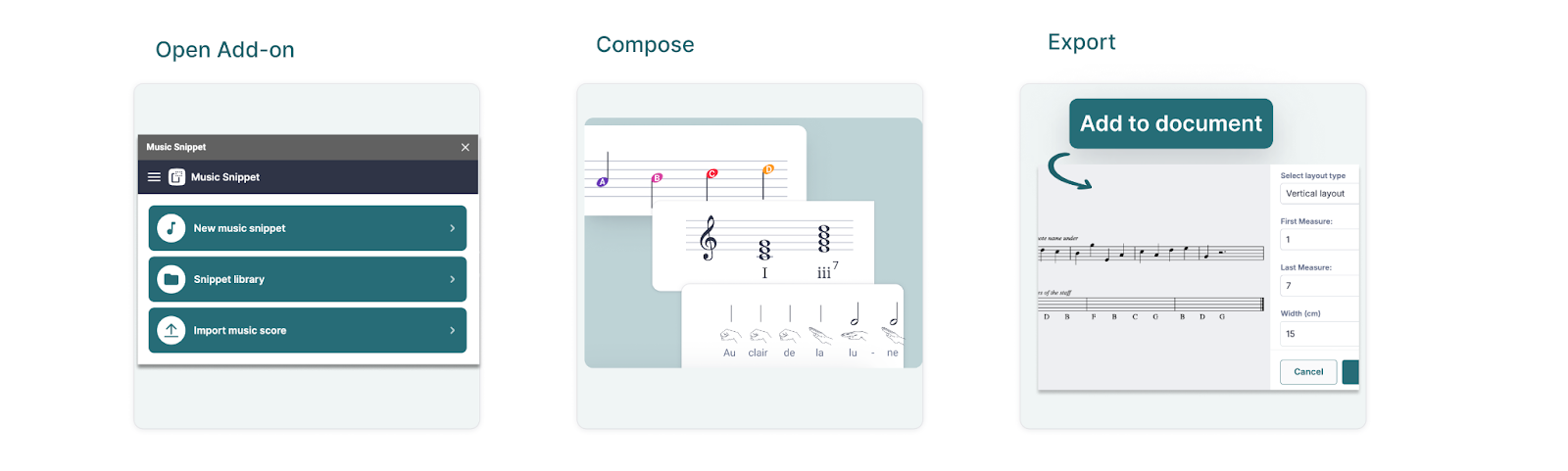
Angela has since brought in a guitar teacher to expand the curriculum. Because both teachers have Music Snippet, adding notation for a new instrument is as simple as opening the add-on and writing in the new part — everything stays in the same document.
💡 Flat for Education users: If you connect your Flat for Education account to Music Snippet, you unlock the full notation editor, including the ability to save scores to your library and reuse them across documents. This is especially useful when building a multi-lesson curriculum.
💡 If you are just starting with Music Snippet, this guide is for you:
Music Snippet guide
The Result: A Complete, Shareable, Living Curriculum
Angela now has a year-long gospel music curriculum that lives entirely in Google Docs — notation included. It's structured, reusable, and easy to hand off to collaborators. When something needs updating, she opens the add-on, edits the notation in place, and the document updates instantly.
The process that used to take multiple apps and a lot of copy-pasting now happens in one place.
Ready to build your own music curriculum in Google Docs?
Get Music Snippet free on Google Workspace →
Frequently Asked Questions
Can I use Music Snippet without a Flat for Education account? Yes — Music Snippet is free and fully functional as a standalone Google add-on. A Flat for Education account unlocks the full notation editor and score library, but it's not required to get started.
Can multiple teachers collaborate on the same curriculum document? Yes. Because Music Snippet works inside Google Docs, you can share the document with any collaborator. Each collaborator will need their own Music Snippet licence to add or edit notation, but they can all work on the same document simultaneously.
Can I export my curriculum to PDF or Word once it's finished? Yes. Google Docs supports export to PDF, .docx, and other formats. The notation you've embedded with Music Snippet is saved as an image, so it exports cleanly to any format.
What instruments can I write notation for in Music Snippet? Music Snippet supports a wide range of instruments, including pitched instruments, unpitched percussion, guitar tabs, and custom instrument configurations. Recorder fingering is also supported.
Is Music Snippet suitable for teaching gospel music specifically? Music Snippet is instrument- and genre-agnostic — you write whatever notation you need. Angela's curriculum covers gospel-specific concepts like chord progressions, natural number systems, and vocal fold exercises, all of which can be notated and embedded using the tool.
Many thanks to Angela for joining us and sharing her musical journey 🎼 🎼
If you’d like to find out more about how Music Snippet could make your presentations or teaching routine easier, check out its full list of features here.
References:
- Hennessy, S. (2000). Overcoming the red-feeling: the development of confidence to teach music in primary school amongst student teachers. British Journal of Music Education, 17, 183 - 196. https://doi.org/10.1017/S0265051700000243.
- Ballantyne, J., & Packer, J. (2004). Effectiveness of preservice music teacher education programs: Perceptions of early-career music teachers. Music Education Research, 6, 299 - 312. https://doi.org/10.1080/1461380042000281749.